
01 · Recorded
A person, in a room, in their dialect
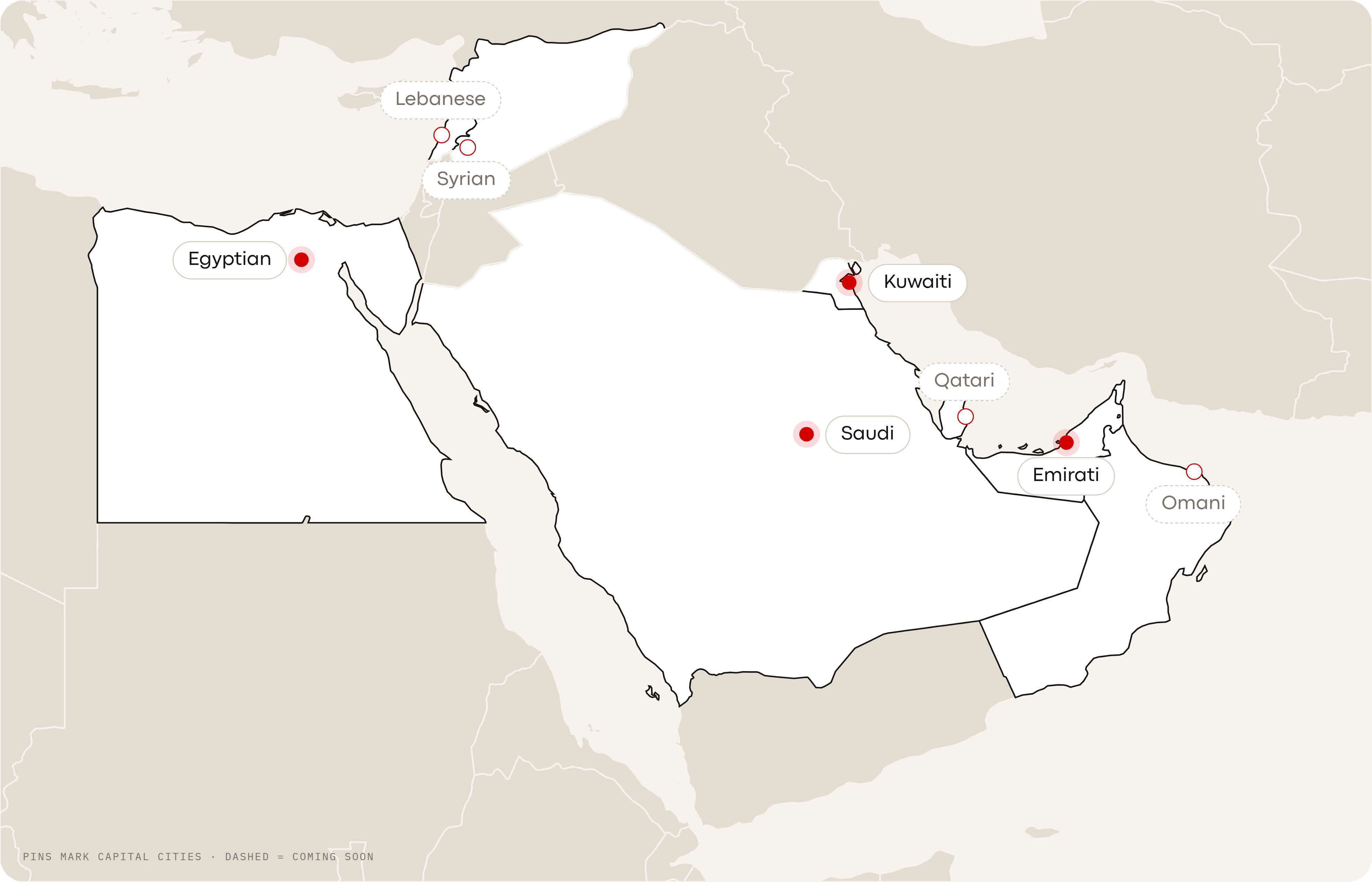
Not a dataset, but voices of people from Sharjah, Jeddah, Kuwait and Cairo, professionally recorded and speaking as they do at home.
Twenty voices available now, across eleven ways of speaking: eight Arabic dialects, plus Fusha and American and British English. Each voice was recorded by a speaker from its own community. Choose one, listen and use it.
A professional voice for a range of use cases.
One list. Click a row to hear it.
Being recorded now. The first voices land here when they are ready.
Being recorded now. The first voices land here when they are ready.
Being recorded now. The first voices land here when they are ready.
Being recorded now. The first voices land here when they are ready.
Five voices and five guesses. Each voice says the same sentence in its own dialect; your task is to identify where it comes from. Most people from the region get four out of five. Systems that support Arabic get none, because they treat them all as one language.
We do not use recordings scraped from the internet. Every voice in the library was recorded by someone from its own community under a signed agreement, and its owner retains the rights. Whenever you use the voice here, its owner is paid. Want to add your voice to the library? Use Voice Cloning.
Not a dataset, but voices of people from Sharjah, Jeddah, Kuwait and Cairo, professionally recorded and speaking as they do at home.
A written agreement says what the voice may be used for. The person can see where it is used and can withdraw it.
Whenever a voice is used, its owner earns from it. Ongoing income from their voice, not a one-time payment. Coming Soon
The library is an endpoint. List the voices, take a voice id, hand it to Text to Speech or to a Sada agent.
# python
import requests

API = "https://api.echonova.ai"
AUTH = dict(Authorization="Bearer YOUR_API_KEY")

voices = requests.get(API + "/v1/text-to-speech/voices", headers=AUTH)
ahmed = next(v for v in voices.json()["data"]["items"]
             if v["name"] == "ae_ahmed")

res = requests.post(
    API + "/v1/text-to-speech/sync",
    headers=AUTH,
    json=dict(text="هلا والله", voiceId=ahmed["id"]),
)
Security & sovereignty
 Speech to Text
Convert audio to text in real time or in batches, across eight dialects.
 Text to Speech
Natural Arabic voices in the caller’s own dialect.
Noise and echo are removed before the model listens to the audio.
From calls, apps or recordings.
Listen to the available samples, compare dialects and choose a voice that matches the audience and content.
Use the Text to Speech demo or follow the API documentation to generate speech with an available voice.

Sovereign Arabic voice AI